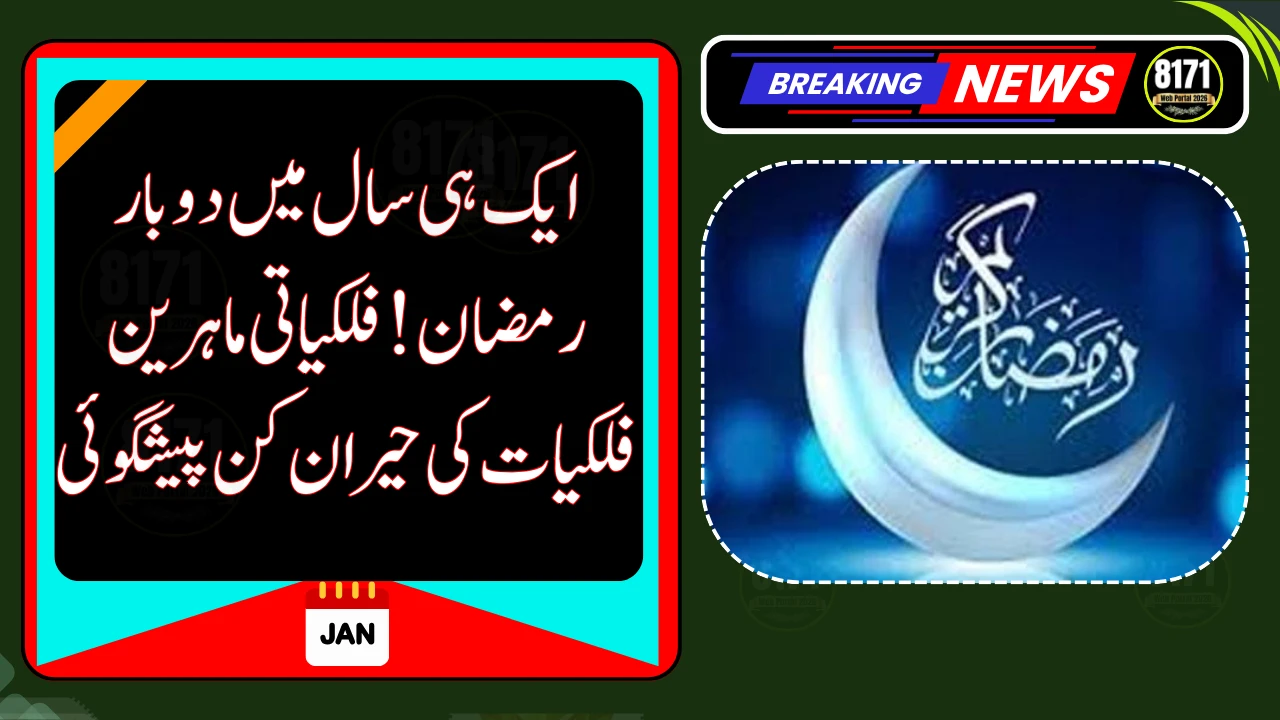
Muslims around the world, including in the UAE and South Asia, are expected to experience a rare and fascinating phenomenon in 2030, when the holy month of Ramadan will occur twice within the same Gregorian year. Astronomers and Islamic scholars say this unique event is the result of differences between the Islamic lunar calendar and the Gregorian solar calendar.



Why Does Ramadan Move Every Year?
The Islamic calendar is based on the lunar cycle, while the Gregorian calendar follows the Earth’s rotation around the Sun. An Islamic year consists of 354 days, which is around 10 to 11 days shorter than a solar year. Due to this difference, Ramadan shifts earlier each year on the Gregorian calendar.



When Will Ramadan Begin in 2030?
According to astronomical calculations:
-
The first Ramadan of 2030 will begin around January 5, 2030, marking the start of Hijri year 1451.
-
The second Ramadan will begin again on December 26, 2030, at the start of Hijri year 1452.
As a result, Muslims will observe two Ramadans in one Gregorian year.
How Many Fasts Will Muslims Observe?
In January 2030, Muslims will observe 30 full fasts, followed by six additional fasts at the end of December. This means a total of 36 fasts in one calendar year, a rare occurrence that excites both scholars and worshippers.
How Rare Is This Event?
This phenomenon happens approximately once every 33 years, as lunar months gradually move through all seasons. The last time this occurred was in 1997, and after 2030, it is expected to happen again in 2063.
Fasting Hours and Moon Sighting
During Ramadan, Muslims fast from dawn (Fajr) to sunset (Maghrib). The length of fasting varies by season—shorter in winter and longer in summer, sometimes exceeding 17 hours in certain regions.
Although astronomical calculations can predict Ramadan’s start, most Muslim countries officially begin the month after moon sighting (Ruet-e-Hilal). Some countries rely on scientific methods, while others follow traditional visual sighting.
A Memorable Spiritual Opportunity
Experts believe that the double Ramadan of 2030 will be a unique spiritual experience, offering Muslims an extraordinary opportunity for worship, patience, and self-reflection within a single year.